
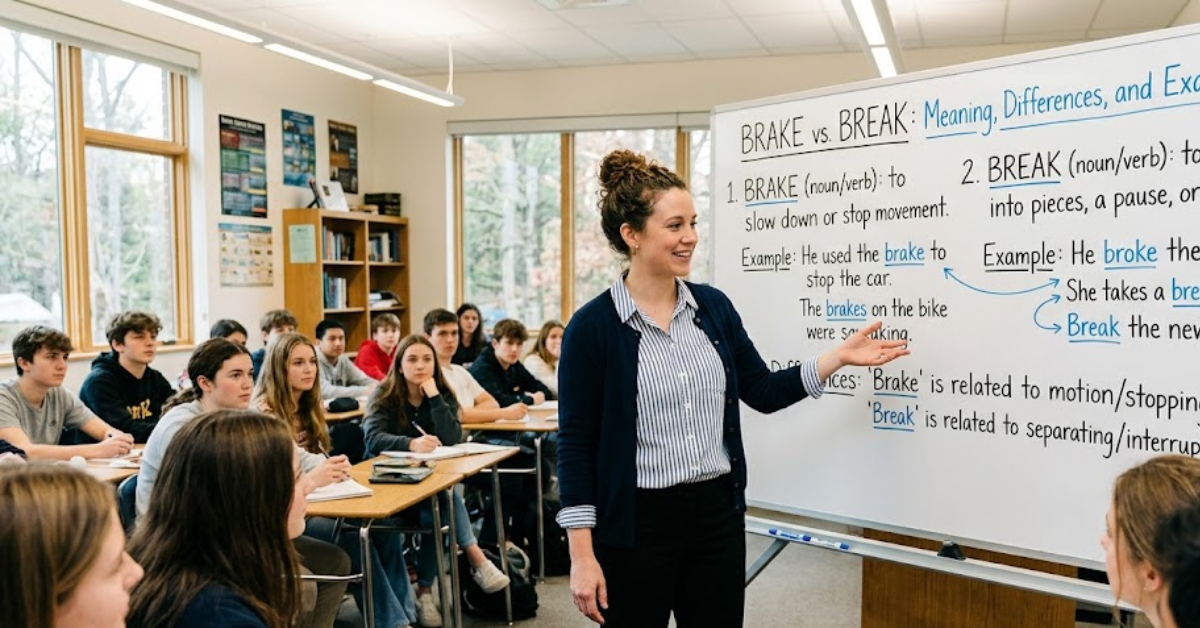
Have you ever typed “brake” when you meant “break,” or paused mid-sentence wondering which spelling is correct? You’re definitely not alone. The confusion around brake vs break is extremely common because the two words sound exactly alike but have completely different meanings.
English is full of tricky homophones, and this pair causes problems for students, writers, drivers, and even native speakers. In this guide, you’ll learn the difference between these words, how to use them correctly, and simple tricks to remember them forever.
Whether you’re searching for the brake vs break meaning, looking for examples, or trying to improve your grammar and writing skills, this article covers everything in a clear and practical way.
Brake vs Break Meaning
The easiest way to understand these words is to remember that one is related to stopping and the other is related to damaging, separating, or pausing something.
What Does “Brake” Mean?
The word “brake” usually refers to a device used to slow down or stop movement.
Most commonly, it’s connected to vehicles like cars, bikes, trucks, and motorcycles.
Examples:
- Press the brake slowly on wet roads.
- My car’s brake system needs repair.
- The cyclist used the rear brake while turning.
“Brake” can also be used as a verb.
Examples:
- You should brake before the sharp corner.
- The driver braked suddenly to avoid an accident.
What Does “Break” Mean?
“Break” means to separate, damage, interrupt, pause, or stop something.
It has many uses in everyday English.
Examples:
- Be careful not to break the glass.
- We took a short break during the meeting.
- Don’t break your promise.
Unlike “brake,” this word appears in many different contexts beyond transportation.
Brake vs Break Difference
The main difference is simple:
- Brake = stopping movement
- Break = damaging, separating, pausing, or interrupting
Even though they sound identical, their meanings are unrelated.
Here’s a quick memory trick:
- A brake helps a vehicle stop.
- A break means something stops working or separates.
That tiny spelling difference changes the entire meaning of a sentence.
Brake vs Break With Example
Examples make the distinction much easier to remember.
Sentences Using “Brake”
- The mechanic checked the brake pads.
- Always brake gently in heavy traffic.
- Her bicycle brake cable snapped.
Sentences Using “Break”
- I need a coffee break.
- Don’t break the rules.
- The children accidentally broke the window.
Side-by-Side Examples
- Hit the brake before the red light.
- Take a break after two hours of studying.
- The truck failed to brake in time.
- Try not to break the laptop.
Reading the words in context helps train your brain to recognize the correct spelling naturally.
Why People Confuse Brake and Break
There are several reasons why these words create confusion.
They Sound Exactly the Same
These words are homophones, meaning they share the same pronunciation but different meanings and spellings.
Autocorrect Causes Mistakes
Sometimes typing tools replace one word with the other automatically, especially on phones.
Fast Writing Leads to Errors
When people write quickly, they often choose the spelling that “looks right” without thinking about the meaning.
Brake vs Break Pronunciation
Interestingly, there is no pronunciation difference between the two words.
Both are pronounced as:
/breɪk/
They rhyme with:
- cake
- make
- take
- shake
Because pronunciation cannot help distinguish them, context becomes extremely important.
Common Grammar Mistakes
Here are some errors people frequently make.
Incorrect:
- I need to replace my car break pads.
Correct:
- I need to replace my car brake pads.
Another example:
Incorrect:
- Let’s take a quick brake.
Correct:
- Let’s take a quick break.
A good habit is to ask yourself:
“Am I talking about stopping a vehicle or pausing/damaging something?”
That question usually gives you the correct answer immediately.
Brake vs Break Meaning in English
In English grammar and vocabulary, these words belong to completely different categories of meaning.
Brake
Associated with:
- vehicles
- stopping
- slowing down
- control systems
Break
Associated with:
- damage
- interruption
- separation
- rest periods
- rule violations
Although they share pronunciation, they function differently in communication.
Muzzle Brake vs Break
One search phrase people often type is “muzzle brake vs break.”
The correct term is actually muzzle brake.
A muzzle brake is a firearm attachment designed to reduce recoil and redirect gases when a gun is fired.
People mistakenly write “muzzle break” because the words sound alike, but in technical usage, “brake” is the correct spelling because the device helps reduce force, similar to how vehicle brakes reduce motion.
Brake vs Break Meme and Internet Confusion
The internet has turned this spelling mix-up into a running joke.
You’ll often see memes showing:
- broken car parts labeled “breaks”
- someone “taking a brake” from work
- grammar correction jokes
These memes are funny because the mistake is so common. In fact, many social media posts intentionally misuse the words for humor.
Still, in professional writing, using the correct spelling matters.
Easy Tricks to Remember the Difference
Here are a few simple memory hacks.
Remember the “A” in Brake
The “A” in brake can remind you of:
- automobile
- accelerator
- auto repair
Remember the “E” in Break
The “E” in break can remind you of:
- end
- escape
- rest break
Visual Association
Imagine:
- a car using brakes
- a glass breaking
Mental images help reinforce spelling faster than memorization alone.
Brake vs Break Worksheet Practice
Try these quick exercises to test yourself.
Fill in the Blank
- Please ______ before the turn.
- Let’s take a short ______.
- The driver slammed on the ______.
- Be careful not to ______ the plate.
Answers
- brake
- break
- brake
- break
Practicing with short exercises improves long-term memory and writing accuracy.
When to Use Brake
Use “brake” when discussing:
- cars
- bikes
- stopping motion
- slowing down
- driving safety
- mechanical systems
Examples:
- brake pedal
- brake fluid
- emergency brake
When to Use Break
Use “break” when discussing:
- damage
- pauses
- interruptions
- separation
- vacations
- rule violations
Examples:
- lunch break
- coffee break
- break a record
- break the law
Tips for Avoiding Future Mistakes
Here are a few practical ways to stop confusing these words.
Read Your Sentence Carefully
Context usually reveals the correct spelling instantly.
Slow Down While Typing
Many spelling errors happen because of speed.
Use Grammar Tools
Modern writing assistants can catch homophone mistakes.
Practice Through Reading
The more you read correct English, the more natural proper usage becomes.
FAQs
Is it brake or break in a car?
The correct word is “brake” because it refers to the system that slows or stops the vehicle.
What is the difference between brake and break?
“Brake” relates to stopping movement, while “break” means to damage, separate, pause, or interrupt something.
Why are brake and break confusing?
They are homophones, meaning they sound identical but have different spellings and meanings.
Is “take a brake” correct?
No. The correct phrase is “take a break.”
How do you remember brake vs break?
Think of “brake” as connected to automobiles and stopping. Think of “break” as connected to damage or rest.
What does brake mean in English?
“Brake” refers to a device or action used to slow or stop movement.
What does break mean in English?
“Break” means to separate, damage, interrupt, or pause something.
Conclusion
Understanding brake vs break becomes much easier once you focus on context instead of pronunciation. Even though the words sound the same, their meanings are completely different.
Use “brake” for stopping movement, especially in vehicles. Use “break” for pauses, damage, separation, or interruptions.
The more you practice with examples and real sentences, the more natural the distinction will feel. Small spelling choices can make a big difference in communication, especially in professional writing, school assignments, and online content.
If you want to improve your English further, explore other commonly confused word pairs and continue building your vocabulary through regular reading and writing practice.