
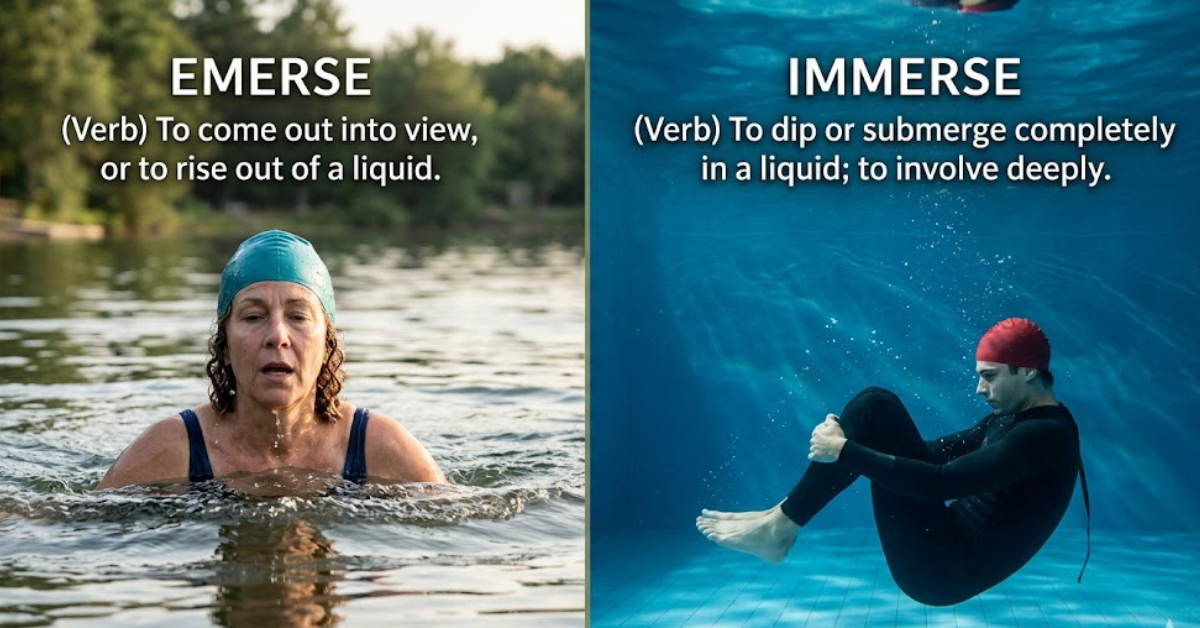
The confusion around emerse vs immerse is more common than you might think. Many people type or hear these words and assume they are interchangeable, but in reality, only one of them is widely correct in modern English usage.
If you’ve ever wondered which word is right, or whether both have the same meaning, this guide breaks it down in a simple and practical way so you can confidently use the correct term in writing and conversation.
What Does Emerse vs Immerse Mean?
Let’s start with the most important question: what does emerse vs immerse actually mean?
The correct word in standard English is “immerse.” The word “emerse” is rarely used today and is generally considered obsolete or incorrect in most modern contexts.
So when people ask what is emerse vs immerse, they are usually comparing:
- “Immerse” (correct and commonly used)
- “Emerse” (rare, outdated, or mistaken spelling)
Immerse Meaning Explained Clearly
To understand emerse vs immerse, you first need to understand “immerse.”
Immerse definition:
To immerse means to:
- Submerge something completely in liquid
- Deeply involve yourself in an activity or experience
Examples:
- She immersed the cloth in water.
- He immersed himself in studying for exams.
In modern English, this is the standard and accepted usage.
What About “Emerse”?
The word “emerse” exists, but it is not commonly used in everyday English.
Emerse meaning (rare usage):
- To emerge or rise out of something (historical or scientific contexts)
However, in most modern writing, “emerse” is considered:
- Outdated
- Rare
- Often confused with spelling mistakes
This is why emerse vs immerse confusion happens frequently.
Key Difference Between Emerse and Immerse
Understanding emerse vs immerse becomes easy when you compare them directly.
Immerse:
- Widely used today
- Means to fully involve or submerge
- Common in daily language
Emerse:
- Rarely used
- Means to rise out or emerge
- Mostly found in technical or historical contexts
So in practical usage, “immerse” is the word you should always choose.
Common Usage of Immerse in Daily Life
The word “immerse” is used in both literal and figurative ways.
Literal meaning:
- Immersing an object in water or liquid
Figurative meaning:
- Immersing yourself in learning
- Immersing in a culture
- Immersing in work or hobbies
This makes it a versatile word in English.
Why People Confuse Emerse vs Immerse
The confusion comes from a few reasons:
- Similar spelling patterns
- Mishearing spoken English
- Typing errors
- Lack of exposure to formal usage
Since “emerse” looks similar to “immerse,” people often assume both are correct.
How to Remember the Correct Word
A simple way to avoid confusion in emerse vs immerse is:
- “Im-” means “into” → immerse = go into fully
- Think of immersion = deep involvement
This memory trick helps ensure you always choose the correct spelling.
Real-Life Examples of Immerse Usage
Here are practical examples showing correct usage:
- Students immerse themselves in study before exams
- Tourists immerse themselves in new cultures
- Gamers immerse themselves in virtual worlds
- Scientists immerse tools in testing solutions
These examples show how common the word is in everyday English.
Is Emerse Ever Correct to Use?
In modern English, “emerse” is rarely needed.
It may appear in:
- Historical texts
- Scientific descriptions (rare cases)
- Academic discussions about language evolution
But for everyday writing, immerse is always correct.
Quick Summary of Emerse vs Immerse
To make it simple:
- “Immerse” = correct, modern, widely used
- “Emerse” = rare, outdated, often unnecessary
- Best choice = always use “immerse”
This clears up the confusion around emerse vs immerse instantly.
FAQs
What is emerse vs immerse?
It refers to two similar-looking words, but only “immerse” is commonly correct in modern English.
Is emerse a real word?
Yes, but it is rarely used today and mostly considered outdated.
What does immerse mean?
To fully involve yourself in something or submerge something completely in liquid.
Which is correct, emerse or immerse?
“Immerse” is the correct and widely accepted form.
Why do people confuse emerse or immerse?
Because of similar spelling and pronunciation patterns.
Can I use emerse in writing?
It’s not recommended unless referring to rare or technical contexts.
Conclusion
The confusion around emerse vs immerse is understandable, but the answer is actually simple. In modern English, “immerse” is the correct and widely accepted word, while “emerse” is rarely used and often unnecessary.
Understanding this difference helps improve both writing clarity and language confidence. So next time you’re unsure, remember this: when in doubt, go with immerse—it’s the standard, correct, and meaningful choice in everyday communication.