
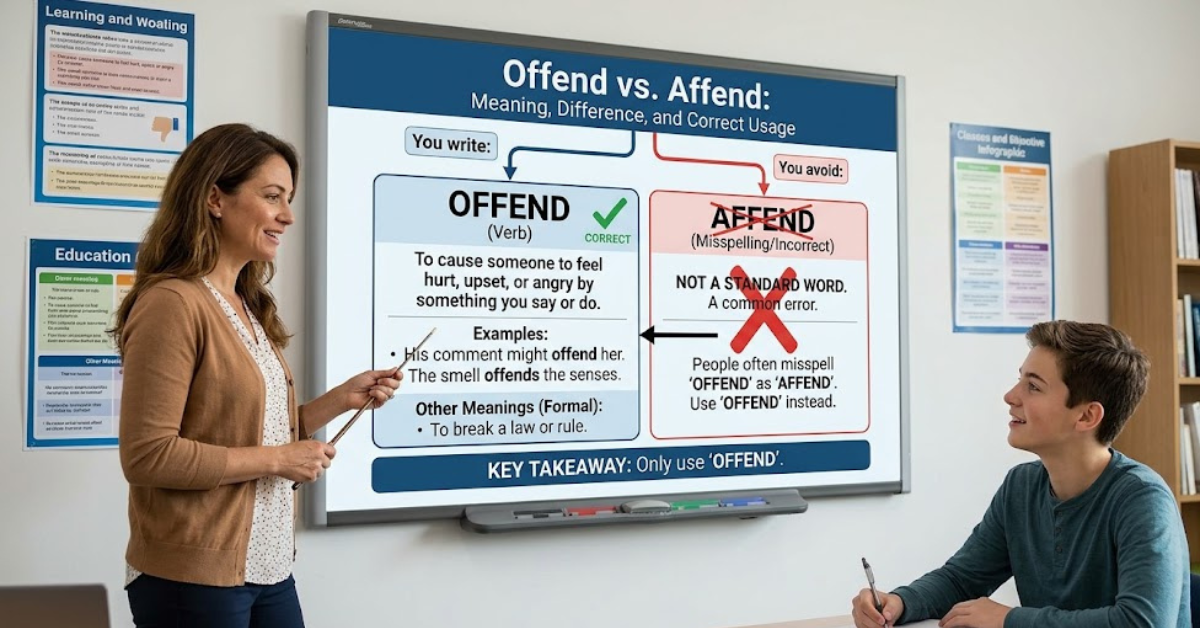
English is full of confusing word pairs, and “Offend vs Affend” is one of the most commonly searched comparisons online. Many people come across the word “affend” in texts, social media posts, or casual conversations and wonder whether it’s a real English word or simply a spelling mistake.
The truth is surprisingly simple: “offend” is the correct standard English word, while “affend” is generally considered a misspelling or a mistaken variation. Still, because the two sound somewhat similar, many learners and even native speakers mix them up.
In this guide, you’ll learn the full offend vs affend meaning, how to use the correct word confidently, common mistakes to avoid, and practical examples that make the difference easy to remember.
What Does “Offend” Mean?
The word “offend” is a legitimate English verb used to describe causing someone emotional hurt, annoyance, insult, or discomfort.
Definition of Offend
“Offend” means:
- To upset or insult someone
- To violate moral or social standards
- To cause displeasure or discomfort
Examples of “Offend” in Sentences
- I didn’t mean to offend you with my comment.
- Loud chewing can offend some people.
- His rude behavior offended the entire group.
- Certain jokes may offend readers.
The word is commonly used in everyday speech, formal writing, media, and professional communication.
Is “Affend” a Real Word?
This is where the confusion begins. In modern English, “affend” is not recognized as a standard dictionary word.
Most of the time, people use “affend” when they actually mean “offend.”
Why Do People Write “Affend”?
There are several reasons:
- Pronunciation confusion
Some accents make “offend” sound slightly different, leading people to spell it incorrectly. - Typing mistakes
Autocorrect errors and fast typing often create nonstandard spellings. - Language learning challenges
Non-native speakers sometimes assume “affend” follows patterns like “affect” or “affirm.” - Social media influence
Incorrect spellings spread quickly online and become accidentally normalized.
So when discussing offend vs affend meaning, remember that only “offend” is grammatically correct in standard English usage.
Offend vs Affend: Key Difference
The easiest way to understand the distinction is this:
- “Offend” = correct English word
- “Affend” = incorrect or nonstandard spelling
Quick Comparison
Offend
- Correct spelling
- Found in dictionaries
- Used in formal and informal English
- Means to insult or upset
Affend
- Generally incorrect
- Not accepted in standard grammar
- Often a spelling error
- Should usually be replaced with “offend”
How to Use “Offend” Correctly
Using “offend” properly is fairly simple once you understand its context.
Common Sentence Structures
1. Offend + Person
- I hope I didn’t offend her.
- The statement offended many viewers.
2. Be Offended By
- She was offended by the remark.
- They felt offended by the criticism.
3. Offend Someone’s Beliefs or Values
- The advertisement offended religious groups.
- His comments offended cultural traditions.
Synonyms of “Offend”
Learning similar words can help strengthen your vocabulary and improve writing naturally.
Common Synonyms
- Insult
- Upset
- Hurt
- Annoy
- Irritate
- Disrespect
- Disturb
Example
Instead of:
- “He offended me.”
You could also say:
- “He insulted me.”
- “He upset me.”
Common Grammar Mistakes Related to “Offend”
People often make small grammatical errors when using the word.
Incorrect Usage
- He was very offend.
- I didn’t want to affend anyone.
- That joke is offensive me.
Correct Usage
- He was very offended.
- I didn’t want to offend anyone.
- That joke is offensive to me.
Notice how the adjective form becomes “offended” or “offensive.”
Word Forms of “Offend”
Understanding different forms of the word helps improve fluency.
Verb
- Offend
Example:
- Don’t offend your customers.
Adjective
- Offensive
- Offended
Examples:
- That language is offensive.
- She felt offended.
Noun
- Offense
Example:
- No offense intended.
Why Correct Spelling Matters
Using the wrong spelling can affect credibility, especially in professional or academic writing.
Correct spelling helps with:
- Better communication
- Stronger writing skills
- Professionalism
- Academic accuracy
Even small spelling mistakes can distract readers or change how seriously your message is taken.
Easy Trick to Remember the Correct Word
A simple memory trick can help you avoid confusion forever.
Think of this:
- “Offend” starts with “off,” and when someone is offended, they often feel “put off.”
That mental connection makes the correct spelling easier to remember.
Offend in Modern Communication
The word appears frequently in:
- Social media discussions
- Workplace communication
- Political debates
- Cultural conversations
- Entertainment reviews
Because modern communication moves quickly, misunderstandings happen more often. Knowing the correct usage helps you express yourself clearly without confusion.
Cultural Sensitivity and the Word “Offend”
Language changes over time, and what people consider offensive can vary between cultures and individuals.
Important Things to Remember
- Humor can offend different audiences differently.
- Cultural norms influence reactions.
- Intent and interpretation are not always the same.
- Respectful communication matters.
Being mindful of language doesn’t mean avoiding honesty. It simply means communicating thoughtfully.
Frequently Asked Questions
Is “affend” a real English word?
No. In standard modern English, “affend” is generally considered incorrect or a misspelling of “offend.”
What is the correct spelling: offend or affend?
The correct spelling is “offend.”
What does “offend” mean?
It means to upset, insult, annoy, or hurt someone emotionally.
Why do people say “affend”?
Usually because of pronunciation confusion, typing mistakes, or misunderstanding of English spelling patterns.
Can “offend” be used formally?
Yes. The word works in both formal and informal communication.
What is the noun form of “offend”?
The noun form is “offense.”
What is the adjective form of “offend”?
Common adjective forms include “offended” and “offensive.”
Conclusion
Understanding the difference between Offend vs Affend is actually quite straightforward once you break it down. “Offend” is the correct and accepted English word used to describe causing emotional hurt, insult, or discomfort. “Affend,” on the other hand, is usually just a spelling mistake that appears due to pronunciation confusion or typing errors.
If you want your writing to sound polished and professional, always choose “offend.” Paying attention to small spelling details improves clarity, communication, and confidence in both speaking and writing.
You can also continue building your vocabulary by exploring other commonly confused English words and grammar comparisons.