Have you ever typed a sentence and suddenly wondered, “Is it invision or envision?” You’re not alone. This is one of those common English mix-ups that catches even experienced writers off guard. Since both words sound similar, it’s easy to assume they can be used interchangeably.
The truth is simple: “envision” is the correct standard English word, while “invision” is usually considered a misspelling in everyday writing. However, there’s a little more to the story, especially because “InVision” is also a well-known brand name in the design world.
In this guide, you’ll learn the difference between the two terms, their meanings, correct usage, examples, and how to avoid making the mistake in professional or academic writing.
Is It Invision or Envision?
The correct word in standard English is envision.
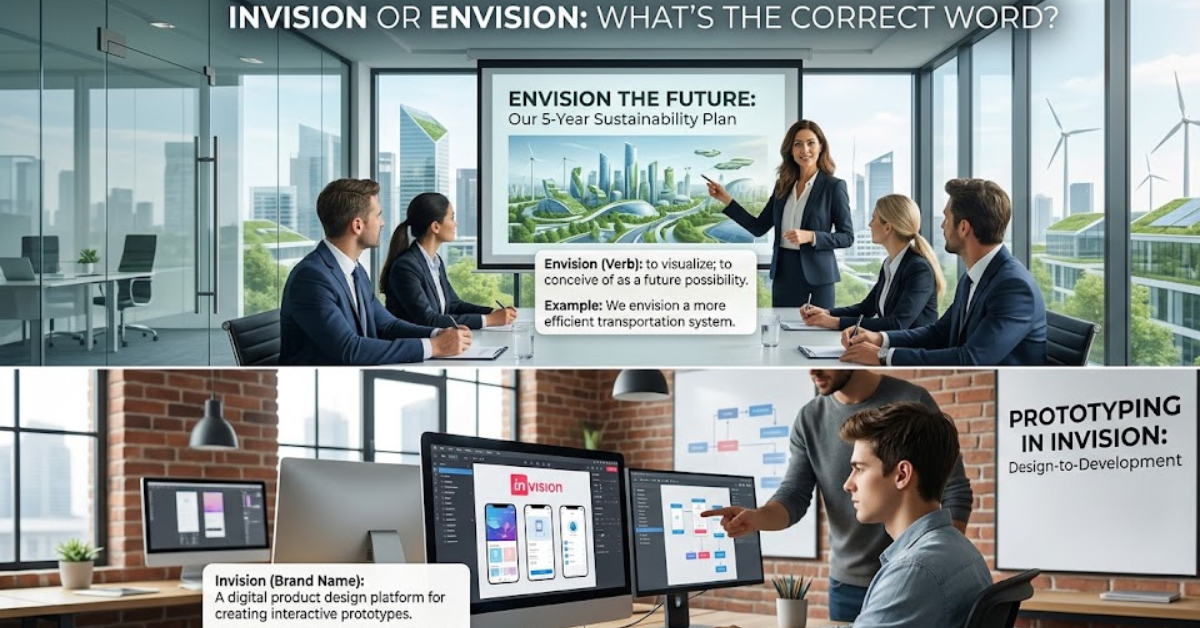
“Envision” means to imagine, picture, or visualize something mentally, especially something related to the future.
For example:
- She could envision herself running a successful business.
- The architect envisioned a modern and sustainable building.
- I can envision the project becoming a huge success.
On the other hand, “invision” is generally not recognized as a standard dictionary word. Most of the time, it appears because of spelling confusion.
Envision Meaning Explained
The word “envision” comes from the prefix “en-” combined with “vision.” Together, they create the idea of forming a mental image.
Common meanings of envision include:
- To imagine a future possibility
- To picture something clearly in your mind
- To anticipate an outcome
- To dream about a goal or idea
It’s often used in professional, creative, motivational, and academic contexts.
Examples in everyday language
- Teachers envision a better future for their students.
- Entrepreneurs envision innovative solutions to problems.
- Many people envision their ideal lifestyle long before achieving it.
Because the word relates to imagination and foresight, it’s especially common in business, leadership, and personal development writing.
Why People Confuse Invision and Envision
The confusion mainly happens because the words sound nearly identical when spoken aloud.
Here are the biggest reasons people mix them up:
1. Similar pronunciation
In fast conversation, “envision” may sound like “invision,” especially in certain accents.
2. Auto-correct and typing habits
People often type based on sound rather than spelling. Since “in” is a very common English prefix, many assume the word starts with it.
3. Brand influence
A major reason for the confusion is the company name InVision, a popular digital product design platform. Seeing the brand name online can make people think “invision” is also a standard English word.
When “InVision” Is Actually Correct
“InVision” with a capital “I” refers to the software company and collaboration platform used by designers and developers.
In that context, the spelling is completely correct because it’s a proper brand name.
For example:
- Our design team uses InVision for prototypes.
- The company migrated projects from InVision to another platform.
But outside the brand context, “envision” remains the grammatically correct choice.
How to Remember the Correct Spelling
A simple trick can help you avoid this mistake permanently.
Think of the word vision.
When you envision something, you are giving yourself a vision of the future. The prefix “en-” often means “to cause” or “to put into.”
So:
- Envision = to create a vision in your mind
This memory shortcut makes the spelling easier to remember.
Common Sentences Using Envision
Seeing the word in context helps reinforce proper usage.
Professional examples
- The CEO envisioned global expansion within five years.
- Engineers envision smarter transportation systems.
Personal examples
- I envision living near the ocean someday.
- Can you envision the final result?
Creative examples
- The author envisioned an entirely new fantasy world.
- Artists often envision ideas before creating them.
Incorrect Uses of “Invision”
Here are examples that should be corrected:
Incorrect:
- I invision a better future.
Correct:
- I envision a better future.
Incorrect:
- She invisioned the project perfectly.
Correct:
- She envisioned the project perfectly.
Unless you’re specifically referring to the brand name, using “invision” in formal writing is considered an error.
Grammar Tips Related to Envision
Understanding how the word functions in sentences can improve your writing.
Verb forms
- Present: envision
- Past: envisioned
- Present participle: envisioning
Sentence patterns
The word is commonly followed by:
- A noun
- She envisioned success.
- A pronoun + verb
- He envisioned himself becoming a doctor.
- A future scenario
- They envisioned how technology would evolve.
Synonyms for Envision
If you want variety in your writing, these alternatives can work depending on context:
- Imagine
- Visualize
- Picture
- Foresee
- Anticipate
- Conceive
- Dream of
Each carries slightly different shades of meaning, but all connect to mental imagery or future thinking.
Why Correct Spelling Matters
Spelling mistakes may seem minor, but they can affect credibility, especially in professional settings.
Using the wrong version can:
- Reduce trust in your writing
- Make academic work look careless
- Create confusion for readers
Writers, students, marketers, and professionals benefit from using precise language consistently.
Invision or Envision Meaning in Online Searches
Many people search phrases like:
- invision or envision meaning
- is it invision or envision
- envision definition
- how to spell envision
These searches show that the confusion is widespread. Fortunately, once you understand the distinction, the correct choice becomes much easier to remember.
Frequently Asked Questions
Is “invision” a real word?
Not in standard English usage. It is usually considered a misspelling of “envision.” However, “InVision” is a legitimate company name.
What does envision mean?
“Envision” means to imagine or picture something mentally, especially a future possibility or goal.
Why do people write “invision” instead of “envision”?
The mistake usually happens because the words sound alike when spoken.
Can I use “invision” in formal writing?
No. In formal, academic, and professional writing, “envision” is the correct spelling unless you are referring to the brand name InVision.
Is envision a verb?
Yes. It is a verb used to describe imagining or visualizing something.
What is the difference between envision and imagine?
“Imagine” is broader and more casual, while “envision” often implies a clearer or future-oriented mental picture.
Conclusion
If you’ve ever wondered whether to use “invision or envision,” the answer is straightforward: “envision” is the correct English word in most situations. It means to imagine, visualize, or picture something mentally, especially related to the future.
“Invision” is typically just a spelling mistake, except when referring to the brand name InVision.
Mastering small distinctions like this can sharpen your writing, improve communication, and help you sound more polished in both personal and professional settings. Keep practicing correct usage, and soon the difference will feel completely natural.