
Imagine you’re driving down the road when a car suddenly pulls out in front of you. In that split second, your reaction can make all the difference. Knowing how should you use anti-lock brakes when you need to stop in an emergency is a critical driving skill that can help you maintain control of your vehicle and potentially avoid a collision.
Modern vehicles are equipped with Anti-Lock Braking Systems (ABS), a safety feature designed to prevent the wheels from locking up during hard braking. However, many drivers are unsure how to use ABS correctly during an emergency stop. Some instinctively pump the brakes, while others release pressure when they feel the brake pedal vibrate.
This guide explains exactly how anti-lock brakes work, the proper emergency braking technique, and common mistakes to avoid.
What Are Anti-Lock Brakes (ABS)?
Anti-lock brakes, commonly known as ABS, are designed to help drivers maintain steering control during sudden or hard braking.
When you slam on the brakes, wheels can lock up and skid. ABS rapidly applies and releases brake pressure many times per second to prevent this from happening.
Key Benefits of ABS
- Helps maintain steering control
- Reduces the risk of skidding
- Improves vehicle stability
- Helps drivers avoid obstacles during emergency stops
- Enhances safety on wet and slippery roads
Today, ABS is standard equipment on most passenger vehicles.
How Should You Use Anti-Lock Brakes When You Need to Stop in an Emergency?
The correct method is simple:
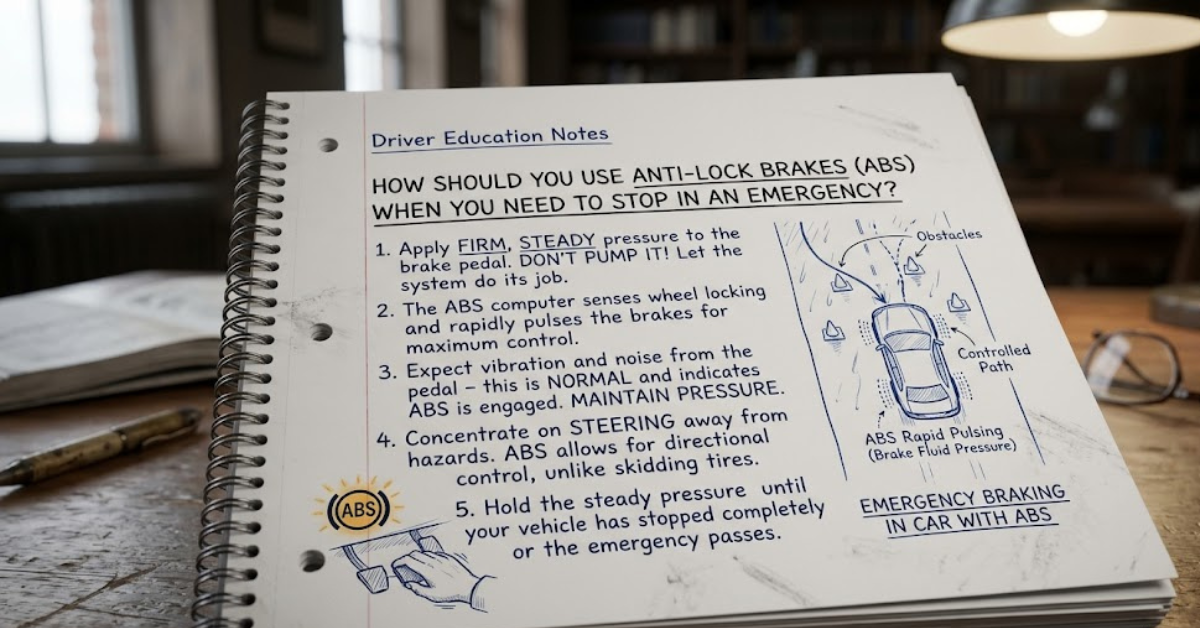
Press Firmly and Hold
When an emergency occurs:
- Apply firm pressure to the brake pedal immediately.
- Press the pedal as hard as necessary.
- Keep steady pressure on the brake pedal.
- Continue steering as needed to avoid obstacles.
- Do not release the brakes until the vehicle stops or the danger passes.
This technique is often summarized as:
“Stomp, Stay, and Steer.”
- Stomp on the brake pedal.
- Stay on the brake pedal.
- Steer around hazards if necessary.
Why You Should Not Pump ABS Brakes
One of the biggest misconceptions about emergency braking involves pumping the brakes.
Before ABS became common, drivers were often taught to manually pump brakes to prevent wheel lockup.
However, ABS already performs this function automatically.
Pumping the Brakes Can Reduce Effectiveness
If your vehicle has ABS:
Don’t pump the brakes.
Instead:
Apply firm, continuous pressure.
Pumping the pedal can interfere with the system’s ability to work properly and may increase stopping distance.
What Does ABS Feel Like During Emergency Braking?
Many drivers become alarmed when ABS activates for the first time.
Common Sensations
When ABS engages, you may notice:
- Rapid brake pedal vibrations
- Pulsing sensations
- Clicking or grinding noises
- Slight pedal movement
These sensations are normal.
What Should You Do?
Keep pressing the brake pedal firmly.
Do not release pressure because of the vibration.
The system is functioning exactly as intended.
How ABS Helps You Maintain Control
One of the greatest advantages of anti-lock brakes is the ability to steer while braking.
Without ABS, locked wheels can cause a vehicle to slide uncontrollably.
With ABS
Drivers can:
- Continue steering
- Avoid obstacles
- Maintain directional control
- Reduce the likelihood of spin-outs
This is especially important during sudden emergencies.
Emergency Stopping on Different Road Conditions
ABS performs well on various surfaces, but road conditions still affect stopping distance.
Dry Roads
ABS provides excellent stability and control.
Drivers can:
- Brake hard
- Maintain steering capability
- Stop efficiently
Wet Roads
ABS helps prevent hydroplaning-related skids, although extra stopping distance may still be required.
Snow and Ice
ABS can improve steering control, but stopping distances may increase significantly due to reduced traction.
Gravel Roads
On loose surfaces, ABS may increase stopping distance slightly while still helping maintain steering control.
Common ABS Emergency Braking Mistakes
Knowing what not to do is just as important as knowing the correct technique.
Mistake #1: Pumping the Brakes
This is the most common error.
ABS already pumps the brakes automatically.
Mistake #2: Releasing the Pedal When It Vibrates
Drivers sometimes think something is wrong when they feel pedal pulsing.
In reality, vibration indicates that ABS is working.
Mistake #3: Looking at the Hazard
Many drivers unintentionally steer toward what they’re staring at.
Instead:
- Look where you want the vehicle to go.
- Focus on a safe escape path.
Mistake #4: Following Too Closely
ABS improves control but does not eliminate the need for safe following distances.
ABS vs Non-ABS Braking
Understanding the difference can help clarify why emergency braking techniques have changed.
| Feature | ABS Vehicles | Non-ABS Vehicles |
| Wheel Lock Prevention | Automatic | Manual |
| Brake Pumping | Not recommended | May be required |
| Steering During Hard Braking | Easier | More difficult |
| Skid Prevention | Better | Limited |
Most modern drivers should follow ABS braking procedures.
How to Know If Your Vehicle Has ABS
Many vehicles manufactured in recent decades include ABS as standard equipment.
Ways to Check
- Look for an ABS indicator on the dashboard.
- Check the owner’s manual.
- Review the vehicle specifications.
- Look for an ABS warning light when starting the vehicle.
If you’re unsure, consult your owner’s manual.
Tips for Practicing Emergency Braking
It’s helpful to become familiar with ABS before a real emergency occurs.
Safe Practice Tips
Choose a safe location such as:
- An empty parking lot
- A closed driving course
- A driver training facility
Practice:
- Firm braking
- Feeling ABS activation
- Maintaining steering control
This can help reduce panic during actual emergencies.
Why Understanding ABS Can Save Lives
According to road safety experts, many crashes occur because drivers react incorrectly during emergency situations.
Knowing how anti-lock brakes function allows you to:
- Respond faster
- Maintain control
- Reduce skidding
- Improve collision avoidance
A few seconds of correct braking can make a significant difference.
Frequently Asked Questions
How should you use anti-lock brakes when you need to stop in an emergency?
Apply firm, steady pressure to the brake pedal and hold it. Do not pump the brakes.
Should you pump ABS brakes?
No. ABS automatically pumps the brakes for you. Pumping the pedal can reduce braking effectiveness.
Why does my brake pedal vibrate when ABS activates?
The vibration is normal and indicates the ABS system is working to prevent wheel lockup.
Can I steer while using ABS?
Yes. One of the main benefits of ABS is maintaining steering control during hard braking.
Does ABS reduce stopping distance?
In many situations, ABS helps drivers stop safely while maintaining control. However, stopping distance can still vary based on road conditions.
Does ABS work on snow and ice?
Yes, but stopping distances may still be longer because traction is reduced on slippery surfaces.
What is the correct ABS emergency braking technique?
The recommended approach is:
- Press firmly
- Hold steady pressure
- Steer if necessary
Conclusion
Understanding how should you use anti-lock brakes when you need to stop in an emergency is one of the most important safety skills every driver should know. The correct method is simple: apply firm pressure to the brake pedal, keep your foot down, and continue steering as needed. Avoid pumping the brakes, and don’t be alarmed by vibrations or pulsing sensations, as these are signs that the ABS system is functioning properly.
By learning how ABS works and practicing emergency braking techniques, you can improve your confidence behind the wheel and increase your ability to respond effectively during unexpected situations. Safe driving starts with preparation, and knowing how to use anti-lock brakes correctly could one day help you avoid a serious accident.